
More barrels are worn out by careless cleaning than by shooting. That is not a reason to skip it — it is a reason to understand what the tools are doing before you push anything down a bore.
This guide covers the one rule that matters most, what separates a good rod from a bad one, what the chemicals actually do, and four kits worth buying.
Clean from the breech, not the muzzle
If you take one thing from this page, take this. Push the rod in from the chamber end and out through the muzzle, in the same direction the bullet travels.
The reason is the crown — the machined face at the muzzle where the rifling ends. It is the last thing touching the bullet, and it governs how cleanly the bullet releases. Even minor wear there degrades accuracy, and a steel rod dragged repeatedly across that edge is exactly how minor wear happens.
Some firearms will not let you do this. Many semi-automatic rifles and lever guns give you no access from the chamber, and in that case you clean from the muzzle carefully, using a guide, and you accept the tradeoff. But where you have the choice, take the breech every time.
Bore guides
A bore guide is a simple sleeve that fits the chamber and holds the rod centered as it enters. It stops the rod rubbing the throat and keeps solvent out of the action.
Not glamorous, and not in most starter kits. But a rod that enters straight does not scrape, and a rod that scrapes does its damage slowly enough that you will not notice until the groups open up.
What separates a good rod from a bad one
- One-piece beats sectional. The joints on a sectional rod leave a lip, and that lip can catch the bore or the crown. Cheap kits use sectional rods because they pack smaller.
- Coated rods need wiping. A soft coating over a rigid core is the usual recommendation, but grit embeds in that coating and then rides against the bore. Wipe the rod every few passes and the problem goes away.
- Soft jags, sparing brushes. Jags in soft metal or plastic reduce bore wear. Bronze brushes have their place for heavy fouling, but they pick up abrasive particles, so they are not a thing to reach for every session.
The general principle: anything hard, gritty, or misaligned is what hurts a barrel. Solvent is not the risk. Mechanical contact is.
Pull-through cables sidestep the problem
Cable systems — Otis kits and BoreSnakes — replace the rigid rod with a flexible cable or weighted cord you drop through from the chamber and pull out the muzzle.
That design solves several problems at once. It only works in the correct direction, it cannot be pushed crooked into the throat, and it packs into a pocket of a range bag rather than needing a bench. The tradeoff is less mechanical leverage on genuinely stubborn fouling, where a rod and a brush still win.
For most shooters cleaning a range gun after a range session, a cable is the more sensible tool and the harder one to misuse.
What the chemicals actually do
Three separate jobs, often sold in one bottle:
- Solvent dissolves powder fouling and copper or lead deposits. This is the part doing the cleaning.
- Lubricant reduces friction and wear on moving parts. Bearing surfaces, rails, and the action — not the bore.
- Protectant leaves a film that resists corrosion between sessions.
A CLP does all three adequately and nothing exceptionally. That is the right trade for most people. Dedicated solvents clean harder, dedicated oils lubricate better, and if you shoot enough to notice the difference you already know which you need.
Work in ventilation, and treat solvent-soaked patches as something to dispose of properly rather than leave in a bin indoors.
The picks
Otis Tactical Universal — the one to buy first

Otis built their reputation on flexible cable systems, and the design does the right thing by default: the cable goes in at the chamber and pulls out the muzzle, which is the direction this whole page argues for. There is no rod to push crooked and no crown to scrape.
It covers a wide caliber range from one compact case, which matters if you own a pistol and a rifle and do not want two kits. Chemicals are bought separately.
If you want one kit and you are not running a precision bench, start here.
GLORYFIRE Elite — the full bench kit

A comprehensive rod-and-brush kit in a case, covering handgun, rifle and shotgun. This is the traditional approach: rods, jags, bronze brushes, slotted tips, sorted into a box you keep on a bench rather than in a bag.
Rods give you leverage a cable cannot, which is what you want for heavy fouling or a neglected barrel. Apply the earlier advice — wipe the rod, go easy on the bronze, and use a guide if your firearm allows one.
GLORYFIRE is a budget brand rather than an heirloom one. Judge it as a comprehensive starter set at a low price, which is what it is.
Real Avid 9mm Kit — if you only shoot pistol
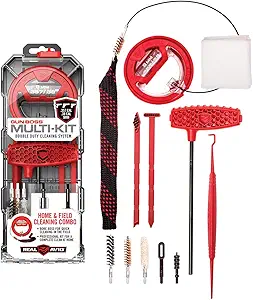
Sized specifically for 9mm, .357 and .38, which is most of what gets fired on a public pistol line. A caliber-specific kit means every brush and jag in it actually fits, instead of hunting through a universal set for the two pieces you need.
Buy this if your safe is handguns. Buy a universal kit if it is not.
Hoppe's BoreSnake — the one that lives in the range bag

A weighted cord with an integrated brush and a long cloth section. Drop the weight through the chamber, pull it out the muzzle, and the bore gets a brush pass and a wipe in a single motion that takes about ten seconds.
It does not replace a proper clean. It does mean the bore gets attention before the rifle goes back in a case, which in practice is the difference between a barrel that gets looked after and one that gets cleaned properly twice a year.
Buy the one matching your caliber — these are caliber-specific, not universal.
How often should you actually clean?
Less often than the internet implies, and more often than most people manage.
A practical approach: wipe the exterior and run a cable or snake through the bore after every range session, do a full clean when accuracy shifts or every few hundred rounds, and clean thoroughly before long storage where corrosion is the real enemy. Corrosive surplus ammunition is a separate case and needs cleaning the same day.
Resist the urge to scrub a bore back to bare metal every time. A light, consistent routine costs the barrel nothing. Aggressive monthly scrubbing with a bronze brush and a sectional rod is how a good barrel gets tired early.
Lead, and where you do this
Cleaning concentrates everything the range put on your firearm. Powder residue and lead particulate come off onto patches, your hands, and the surface underneath.
Work on a mat you keep for the purpose rather than a kitchen table, ventilate the room, wear nitrile gloves if you clean often, and wash your hands with cold water and soap afterwards. The same hygiene logic covered in our range bag guide applies here, and arguably more so.
Common questions
Is a bore snake enough on its own?
For maintenance between sessions, largely yes. For heavy copper fouling or a firearm that has been stored dirty, no — you want solvent, a brush, and time for the solvent to work.
Do I need a bore guide?
If you clean a bolt-action rifle with a rod, it is one of the better small purchases you can make. For pistols and cable systems it matters much less.
Can I use one solvent for everything?
A CLP covers cleaning, lubrication and corrosion protection well enough for general use. Dedicated products outperform it at each individual job.
Is it possible to over-clean?
Yes, and it is more common than under-cleaning among enthusiastic new owners. The damage comes from mechanical contact — rods, brushes, and grit — not from solvent sitting in a bore.
Before you go
The rest of what belongs in a range bag is covered in our guides to electronic ear protection and range bags, and everything else is indexed at range gear. New shooters should read range safety basics first.