
Hearing loss from shooting is permanent, cumulative, and almost entirely preventable. It is also the one injury at the range that gives you no warning — there is no pain in the moment, just a ringing that fades and takes a little of your hearing with it each time.
This guide covers what the numbers on the box actually mean, why the rating is optimistic, and which electronic muffs are worth buying for the kind of shooting you do.
How loud is a gunshot, really?
Peak sound pressure from firearms runs roughly 140 to 175 decibels. Most recreational firearms land between 150 and 165 dB — a .22 rifle sits near 144 dB, while a .357 revolver can reach about 172 dB.
For context, NIOSH recommends that exposure to peak impulse noise never exceed 140 dB. A single unprotected shot at that level uses 100% of your allowable daily noise exposure. OSHA's noise standard sets the same 140 dB ceiling for impulse noise because above it, permanent damage can occur from one exposure.
Decibels are logarithmic, so a 165 dB muzzle blast is not "a bit louder" than the 140 dB threshold — it is enormously more energy. This is why the answer is never "I only fired a few rounds."
What NRR actually means — and why it overstates protection
Every hearing protector sold in the US carries an EPA-mandated Noise Reduction Rating. It is tempting to read NRR 22 as "subtract 22 dB." It does not work that way.
NRR is measured under ideal laboratory conditions with a perfect fit. Real-world use is messier: hair, glasses temples, hat brims, and imperfect seals all cost you attenuation. Regulators account for this by derating the label:
- OSHA requires the labeled NRR be derated by 50% when evaluating whether a protector is adequate. The standard formula is (NRR − 7) ÷ 2 — the 7 converts from C-weighted to A-weighted measurement, and the division applies the safety factor.
- NIOSH is slightly less severe on muffs, derating earmuffs by 25% and earplugs by 50%.
Run an NRR 22 muff through the OSHA formula and you get roughly 7.5 dB of assumed real-world reduction. That is not a reason to distrust the product — it is a reason to treat NRR as a comparison figure between models rather than a promise, and to double up when the environment is genuinely loud.
Electronic or passive?
Passive muffs are foam and plastic. They block everything, including the range officer telling you to cease fire.
Electronic muffs use external microphones to pass through ambient sound at a safe level, then clamp down the instant a shot registers. Howard Leight's Impact Sport, for example, amplifies ambient noise up to a capped 82 dB; most competing designs compress at a similar 85 dB threshold. The compression is fast enough that you hear the shot as a muted thump rather than a crack.
The practical difference is that electronics let you hold a conversation, hear commands, and stay aware of what is happening on the firing line — without lifting a cup off your ear, which is when people actually get hurt. For most shooters this is worth the cost.
Note that the electronics do not add protection. The NRR of an electronic muff comes from the same passive shell; the circuitry only governs what gets let in.
Muffs or in-ear?
Over-ear muffs seal more reliably and are easier to put on correctly, which matters more than the spec sheet suggests. Their drawback is bulk: a thick cup collides with the stock of a rifle or shotgun when you get a proper cheek weld, and it stacks awkwardly under hearing-protection-plus-hat combinations.
Electronic earbuds solve the clearance problem and disappear under a hat, but their rating depends entirely on the tip you install. That is not a footnote — it is the whole rating. See the Axil entry below.
The picks
Howard Leight Impact Sport — NRR 22

The default recommendation for a first pair, and the muff you will see most often on a public firing line. Directional microphones, a conventional deep cup, AAA batteries, and a folding design. The deep cup is fine for handgun shooting and clay sports but will interfere with a rifle stock.
If you want one pair and mostly shoot pistols, buy this and stop reading.
PROHEAR Digital Electronic — NRR 23, low profile

The reason to look past the Impact Sport is cup depth. This one uses a slim shell, and that low profile is the entire point — it keeps the cup clear of the stock when you build a cheek weld on a rifle or shotgun, which a conventional deep cup will not do.
NRR 23, five-times amplification, and compression that clamps anything above 82 dB, which is the same threshold the established brands use. The one-decibel difference against the Impact Sport is not meaningful; choose between them on cup geometry.
PROHEAR is a less established name than Honeywell or 3M, so weigh it on the specification rather than the reputation — and check the headband and cushions on arrival, as those are where cheaper muffs give way first.
3M Peltor Sport Tactical 500 — NRR 25
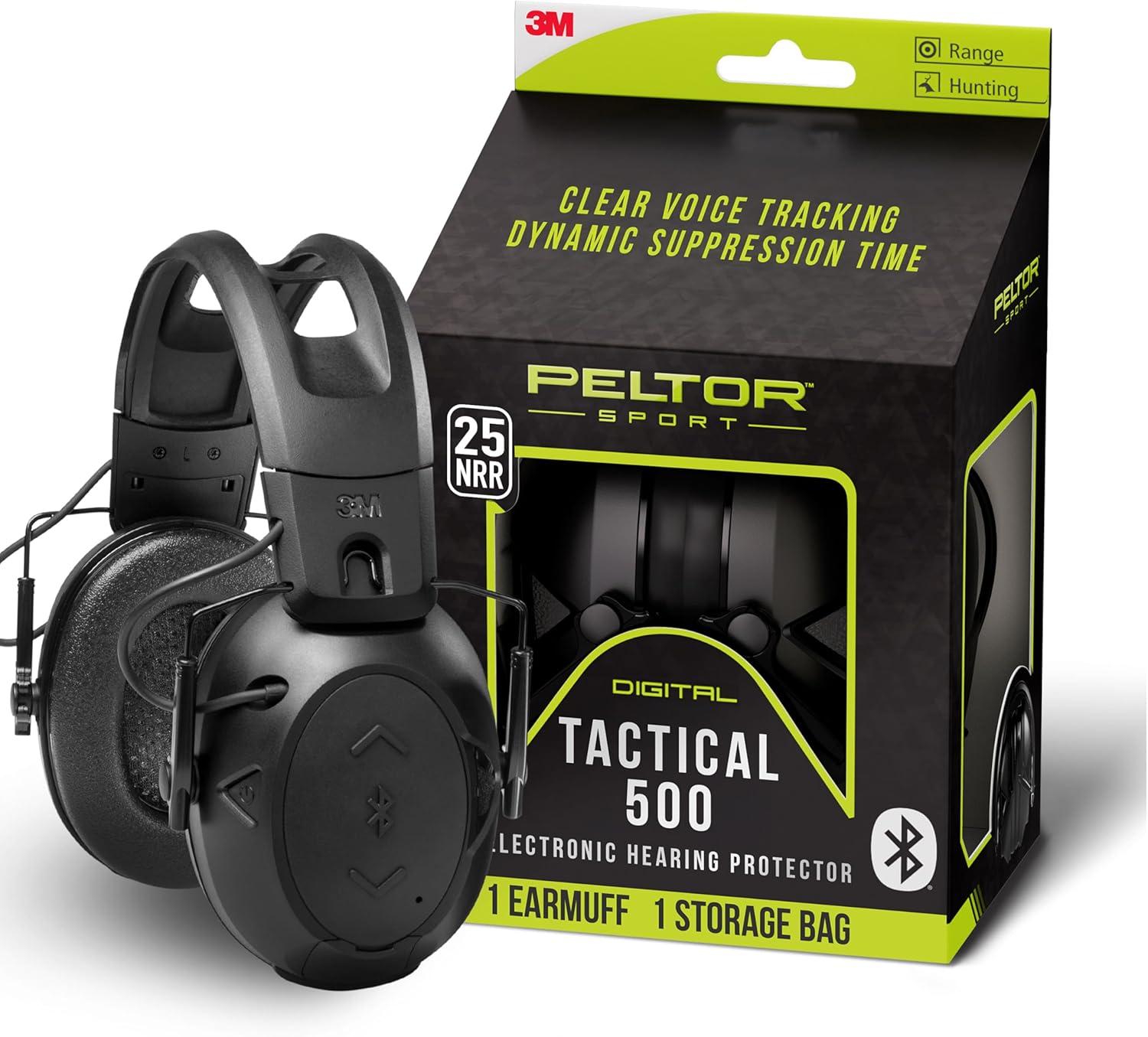
The step up. 3M lists an NRR of 25 dB, and the muff adds gunshot recognition that suppresses impulse noise while handling speech more cleanly than the budget models — the difference is most obvious indoors, where reflected muzzle blast is relentless and cheaper electronics tend to pump and cut out. Bluetooth is included, which is either useful or irrelevant depending on how you shoot.
Worth noting: some retailer listings advertise this as NRR 26. 3M's own product page states 25.
Axil GS Extreme 2.0 — NRR 27 with foam tips

The in-ear option, and the one with a caveat you must not skip. The 27 dB rating applies only with the included Comply foam tips installed. The silicone tips rate lower, around 22 dB, and are not rated for shooting at all. Install the foam tips and leave them in.
With that handled, these are excellent for long guns and hunting: nothing to collide with a stock, nothing under a hat, roughly 25 hours of use per charge, and Bluetooth.
Howard Leight MAX-1 foam plugs — NRR 33

The cheapest meaningful upgrade on this page. NRR 33 is the highest rating available on a disposable foam plug, and worn underneath any of the muffs above they give you the dual protection NIOSH recommends for gunfire exposure.
Roll them tight, pull the ear up and back, insert, and hold until they expand. A plug that has not seated properly is not protecting anything, which is the one way this cheap fix goes wrong.
Doubling up indoors
Indoor ranges are meaningfully worse than outdoor ones. The muzzle blast has nowhere to go, so it reflects off the walls, ceiling, and the lane dividers, and you absorb the report from every shooter on the line, not just your own.
NIOSH recommends dual hearing protection — plugs under muffs — for gunfire exposure. Doubling up does not add the two ratings together; the realistic gain over the better of the two is around 5 to 10 dB. That is still the single most effective thing you can do, and it costs a few dollars in foam plugs.
If you shoot indoors regularly, wear plugs under your electronic muffs and accept that you will hear less. If you are shooting a short-barreled rifle or anything with a muzzle brake, treat doubling up as mandatory rather than optional.
Common questions
Do electronic muffs protect less than passive ones?
No. Protection comes from the passive shell, and the NRR printed on an electronic muff already reflects that. The electronics only control what is allowed through when there is no gunshot.
Is a higher NRR always better?
For pure protection, yes. In practice, the highest-rated protectors cut you off from range commands entirely, which is its own hazard. Match the rating to the environment: more indoors, less outdoors, and double up when it is loud.
Are my kids covered by adult muffs?
Poorly. Adult headbands do not tension correctly on a smaller head, and a bad seal costs you most of the rating. Youth-specific muffs exist for this reason.
What NRR do I need for an indoor range?
There is no single legal number — it depends on the calibers being fired and how many lanes are active. A practical approach is an electronic muff in the mid-20s NRR, plus foam plugs underneath when the line is busy.
Before you go
Eye protection is the other half of this, and the requirements are just as specific — see our guide to shooting glasses and ANSI Z87.1 ratings. For everything else worth packing, start at the range gear index, and review range safety basics before your first visit.
Ready to shoot? Find a range near you.